Marriage and divorce records in Chatham County, Georgia serve as official proof of major life events. These documents record when a marriage begins and when it legally ends through a court order. They include key details such as names of both parties, dates, and the place where the event occurred. As part of structured family documentation, these records help create a reliable history for each person. Government agencies, legal professionals, and researchers rely on them for accurate data. In Savannah, Georgia, which serves as the administrative center of the county, local offices handle the filing and storage of these records. This organized process supports smooth record tracking and retrieval. Many residents use these records for everyday needs, including updating legal documents or confirming marital status.
Since these records connect to the broader public records system, they remain an important source of verified information across different sectors. These records play a strong role in legal record verification and personal documentation. Marriage certificates often support name changes, tax filings, and benefit claims. Divorce records, on the other hand, confirm the legal end of a marriage and outline decisions related to property, custody, or financial matters. Both types of records contribute to effective vital statistics management, helping state and county offices maintain accurate population data. In Chatham County, these records are managed under Georgia law, which allows public review with certain privacy limits.
What Are Marriage and Divorce Records?
Marriage and divorce records are official entries within government systems that track the start and end of marital relationships. These records form part of the broader civil records definition used across the United States. They provide reliable details such as names, dates, and legal outcomes. In many cases, these records act as legal marital status proof for personal and official use. Courts and agencies, including chatham county court rely on them to confirm identity, relationship history, and eligibility for services. Since they are recognized as court-issued documents, they carry legal authority and long-term value.
Legal Meaning and Document Types
Marriage and divorce records fall under structured family law documentation that reflects a person’s legal relationship status. These records are created through formal procedures and stored by government offices. A marriage record confirms that a legal union took place, while a divorce record confirms that the union ended through court action. Both record types support legal clarity and help maintain accurate data in public systems. They also assist courts, employers, and agencies when verifying a person’s marital history or legal obligations.
- Marriage license: Legal permission issued before a wedding ceremony
- Marriage certificates: Final proof that the marriage took place
- Divorce filings: Initial paperwork that begins a divorce case
- Divorce decree: Final court order that ends the marriage
- Judgments and orders: Decisions related to custody, support, or assets
How to Search Marriage and Divorce Records in Chatham County
You can search chatham county marriage records and divorce records chatham county through official online portals or by visiting county offices. The record lookup process requires accurate details like names, dates, and case numbers for best results. To begin, users should collect key information such as full names, approximate dates, and case numbers if available. This improves search accuracy and saves time.
Record Lookup Process and Access Methods
The record lookup process in Chatham County starts by choosing the correct record type. Marriage records are handled by the Probate Court, and divorce records are managed by the Superior Court. Both are stored as official court-issued documents within Georgia’s system. Users can begin with a public database search for quick results or visit courthouse offices for full file access. Each method depends on record age and the level of detail required.
- Online public database search: Quick way to view recent and basic details
- Courthouse archives: Used for older or complete records
- Clerk’s office: Issues certified copies and supports record requests
- Vital records office: Maintains marriage certificates and license data
- Civil case retrieval systems: Track divorce filings and court outcomes
Marriage Application
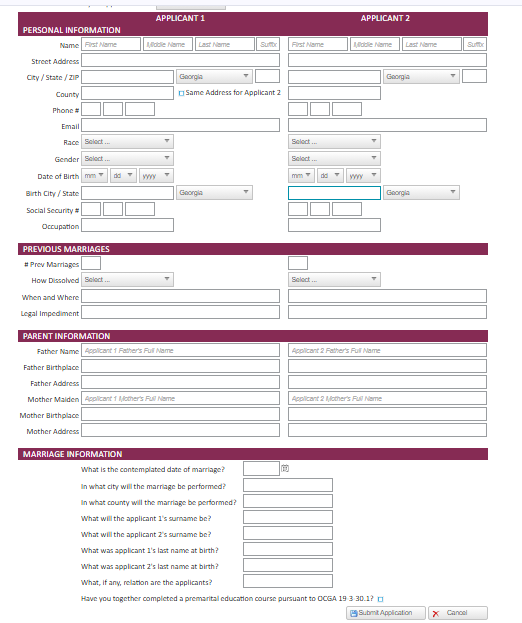
This tool is used to start a marriage record, not to search existing ones. The form in your screenshot includes several sections. Here is a complete explanation of each part so users can fill it correctly.
Official Site: https://www.georgiaprobaterecords.com/Marriage/MarriageApplication.aspx
Personal Information
Each field must be accurate, as it becomes part of official family law documentation. Enter details for both applicants:
- First, middle, and last name
- Full address (city, state, ZIP)
- Phone number and email
- Race and gender
- Date of birth (MM/DD/YYYY format)
- Birth city and state
- Social Security number
- Occupation
Previous Marriages
This helps confirm eligibility for a new license. This section records marital history:
- Number of previous marriages
- How the marriage ended (divorce, death, annulment)
- Date and place of separation
- Legal end date of prior marriage
Parent Information
These details are used for identity verification in official records. Details about parents of both applicants:
- Full names of father and mother
- Birthplaces of parents
- Mother’s maiden name
- Parent addresses
Marriage Information
After completing all sections, users click Submit Application. Final details about the upcoming marriage:
- Planned date of marriage
- City and county where ceremony will take place
- Surname after marriage for each applicant
- Birth surnames of both applicants
- Relationship status between applicants (if any)
- Premarital education course completion (if applicable)
Important Steps After Form Submission
- Save confirmation or reference number
- Visit Probate Court in person
- Bring valid ID and required documents
- Pay applicable fees
- Receive marriage license
Divorce Record System in Chatham County Courts
Divorce records in Chatham County are part of a structured legal system managed by the Superior Court. These records document the full process of ending a marriage, starting from the initial filing and continuing through hearings, motions, and final judgment. Each case becomes part of official family court records, which are stored and indexed for future reference. These documents carry legal authority and are used for identity verification, legal claims, and administrative purposes. The system keeps all information organized within the divorce decree system, allowing courts and agencies to track and verify legal marital status accurately over time. The family court plays a central role in finalizing these cases by reviewing all documents and issuing the final decree. Once completed, the case becomes part of divorce records chatham county, stored within the county’s system for long-term legal and public use.
Court-Based Divorce Documentation Structure
The court-based structure for divorce records in Chatham County follows a step-by-step legal process. Each stage adds new documents to the case file, forming complete legal separation documentation. The process begins with filing a petition and continues through court review until the judge issues a final decision. All records are carefully maintained as part of official civil judgment records, ensuring accuracy and reliability for legal use. Divorce records contain important details such as names of both parties, case numbers, filing dates, and court decisions. These records may include agreements about child custody, financial support, and division of assets. Some information is publicly available through court systems, allowing basic review of case status and outcomes.
- Petition filing: Starts the divorce case in court
- Response and motions: Submitted by both parties during proceedings
- Hearings and reviews: Used to evaluate evidence and resolve disputes
- Final divorce decree: Official court order ending the marriage
- Additional judgments: Cover custody, support, and property division
Vital Records Administration in Chatham County
Chatham county vital records are managed through a coordinated system between county offices and the state of Georgia. These records are stored, updated, and protected within a secure government record system for long-term public and legal use. Vital records administration in Chatham County follows a structured approach that connects local offices with state-level systems. The county handles the initial creation and filing of records, while Georgia maintains a broader database for statewide tracking. This system supports accurate data collection and organized storage of key life event records. Offices such as the probate court, superior court, and the vital statistics office each manage specific types of records. These records include marriage certificates, divorce documents, birth certificates, and death records.
Structure and Record Maintenance
The system structure in Chatham County is designed to keep records accurate, secure, and easy to retrieve when needed. County offices create and file records at the local level, then connect with the Georgia state database to maintain consistency across jurisdictions. This connection allows records to be verified and accessed through official channels. Each type of record follows its own path, but all are stored within a unified government record system that supports long-term use and reliability. Together, they form a complete set of public document storage that reflects important life events within the community.
County and State Record Coordination
Chatham County works closely with Georgia’s statewide system to maintain accurate and consistent records. Local offices are responsible for collecting and recording information at the time of each life event. After that, the data is shared with the state database to create a unified record system. This coordination helps maintain consistency across counties and allows authorized users to verify records efficiently. It also supports long-term tracking and proper documentation within the state. This balance supports both privacy and transparency. Through this structured system, Chatham County maintains reliable records that support legal verification, identity confirmation, and long-term documentation needs.
- County offices handle record creation and filing
- State systems maintain centralized data copies
- Shared databases improve record verification
- Coordinated systems reduce duplication errors
Record Types and Secure Storage
Chatham County maintains different types of vital records, each stored and protected using secure methods. Marriage and divorce records are handled through court systems, while birth and death records are managed by the vital statistics office. Recent records are often stored in digital systems, while older files are preserved in physical archives. This method supports strong archival record maintenance and ensures records remain safe over time. Security is a key part of managing chatham county vital records. Access to sensitive information is controlled, and only authorized users can view restricted data. At the same time, public access rules allow individuals to request copies when permitted by law.
- Marriage records stored by probate court
- Divorce records maintained as civil case files
- Birth and death records managed by vital statistics office
- Digital systems used for recent files
- Physical archives protect historical documents
Legal Access Rules and Record Restrictions
Marriage and divorce records in Chatham County fall under Georgia’s public records law, which allows public review of many government-held documents. Basic details such as names, dates, and case status are often available through court systems or official requests. These records support legal verification, research, and administrative needs. At the same time, the law includes privacy protection rules that limit access to sensitive information. This approach helps keep records useful for the public while protecting personal data. Courts and county offices follow strict procedures when handling requests, making sure that only appropriate information is released.
Privacy and Public Access Balance
The balance between public access and privacy is maintained through clear rules that define which records can be shared. Most chatham county marriage records are considered public and can be requested by anyone with basic information. Similarly, many divorce records chatham county files are available for viewing, especially case summaries and final outcomes. These records help confirm marital status and support legal processes.
Public vs Restricted Records
Public records usually include general case information, while restricted records contain sensitive details. Courts review each case to decide what can be shared and what must remain private. This ensures that personal information is not exposed unnecessarily. In many jurisdictions, laws and regulations guide how records are classified and accessed. Clerks and legal officials follow strict procedures before releasing any documents to the public. Sensitive information such as financial data, medical history, or details involving minors is often protected.
- Public records include names, dates, and case status
- Marriage certificates are usually available upon request
- Divorce case summaries can often be viewed online
- Sealed court cases restrict access to sensitive information
- Financial details and child-related data may be limited
Legal Limits and Third-Party Access
Georgia law places limits on who can request certain records, especially when sensitive data is involved. Third-party access is allowed for general information but may require authorization for full documents. Courts may seal parts of a case to protect privacy, especially in matters involving minors or confidential financial records. These rules create a clear system where legal access rights are respected while maintaining strong privacy protection rules.
- Third parties can request basic record details
- Certified copies may require proof of identity or relationship
- Sealed documents need court approval for access
- Privacy laws protect sensitive personal information
Historical Marriage and Divorce Records Availability
Older family records, including marriage certificates, are stored in county and state archives and can be used for genealogy research. These archived vital records support ancestry tracking, though some limits may apply based on age and condition. Historical marriage and divorce records in Chatham County provide valuable insight for ancestry work and long-term documentation. These records form part of genealogy archives, which preserve past life events for research and legal reference. Many older marriage certificates and related files are stored in physical formats such as bound volumes, microfilm, or secured archive rooms. Some records have been digitized, making them easier to locate through a historical records search system.
Archives and Genealogy Use
Chatham County and the state of Georgia use structured methods to store and maintain older records. County offices preserve documents locally, while state systems may keep backup or indexed versions. This layered storage method protects records and supports long-term archived vital records maintenance. Researchers often use these archives to trace lineage, confirm relationships, and study family history patterns.
Access and Limitations of Historical Records
Access to historical family records depends on record condition, age, and storage format. Some documents are easy to retrieve, while others may require manual searches within courthouse archives. Certain older files may have missing data or may not be fully digitized. These historical records play a key role in genealogy and family research. They help confirm identity, establish timelines, and support accurate ancestry tracking across generations.
- Older records stored in physical archive systems
- Microfilm and digital formats used for preservation
- Limited online access for very old documents
- Some records may be incomplete or damaged
- Manual searches may be required for detailed research
Location and Contact Information
For Chatham County vital records, you need to visit the Probate Court (for marriage records) or the Superior Court Clerk (for divorce records) in Savannah. Both offices are in the same courthouse building and provide in-person record services during working hours. Staff can guide you on request procedures, fees, and required identification. It is recommended to call ahead to confirm office hours and document requirements before your visit. You may also find some forms available online, but most official copies must be obtained directly from the courthouse in person.
Official Office Details
In Savannah, official county office services are primarily handled through the Chatham County Clerk of Superior Court. The main office is located at 133 Montgomery Street, Savannah, GA 31401, inside the Chatham County Courthouse. This office manages court filings, public records, and legal documentation.
- Address: 133 Montgomery Street, Room 509, Savannah, GA 31401
- Phone: (912) 652-7271
- Hours: Monday – Friday, 8:00 AM – 5:00 PM
Frequently Asked Questions
The Frequently Asked Questions section is designed to address common concerns and provide clear, concise information to users. It helps individuals quickly find answers without needing to contact support, saving time and effort. FAQs typically cover essential topics such as procedures, requirements, timelines, and access to services. By organizing information in a simple and user-friendly format, this section improves understanding and reduces confusion. It is especially useful for first-time users who need guidance and for returning users seeking quick clarification on specific issues or processes.
What is the difference between a marriage license and a marriage certificate in Chatham County?
In Chatham County, a marriage license is the legal permission issued before a couple gets married, allowing them to legally perform the ceremony. It does not prove marriage has happened. A marriage certificate is issued after the wedding is completed and officially recorded by the court. It serves as proof that the marriage legally took place. The certificate is part of the permanent public record and is commonly required for legal name changes, benefits, and official documentation purposes in government and private institutions.
How long does it take to get a divorce record finalized and available publicly?
In Chatham County, divorce records become publicly available only after the court has fully finalized the case and completed all administrative processing. The timeline can vary depending on court workload, case complexity, and filing accuracy. Typically, it may take a few weeks for records to be updated in the official system. Once finalized, they are stored as part of court documentation and may be requested as certified copies for legal or personal use, depending on eligibility and access rules.
Can someone access marriage records without being directly involved?
Yes, marriage records in Savannah are generally considered public records, which means they can often be accessed by individuals who are not directly involved in the marriage. However, access may require submitting a formal request and providing identification. Some details may be restricted depending on privacy regulations or record type. Certified copies are usually issued for legal use, while informational copies may be available for general research or verification purposes through the county clerk’s office.
Are older marriage records from Savannah GA still available in archives?
Older marriage records from Savannah are often preserved in county or state archives, depending on their age and condition. Many historical records are maintained for legal and genealogical purposes, though availability can vary. Some records may be digitized, while others exist only in physical form at archival facilities. Accessing very old records may require additional processing time or in-person requests. These archived documents help maintain long-term legal history and support public record transparency in Georgia.
What makes a divorce record restricted or sealed in Georgia courts?
In Georgia courts, a divorce record may be sealed or restricted by a judge to protect sensitive information. This often happens in cases involving minors, domestic safety concerns, financial confidentiality, or privacy protection requests. When sealed, the record is not available to the general public and can only be accessed under specific legal authorization. Restricted records still exist in the court system but have limited visibility, ensuring personal or sensitive details are protected while maintaining legal compliance.